

Staying safe through uncertain times with Quality Management
How senior management teams make their companies more resilient and successful.
Business success can no longer be taken for granted
Economic uncertainty, changing customer requirements, new technologies, competitive pressure and a shortage of skilled workers present companies with major challenges. What has been successful for many years may no longer be so tomorrow.
This raises fundamental questions for management: Are we identifying changes in the market early enough? Will our products and services still be in demand in the future? Where are risks and new opportunities arising? And how can we develop our business in good time without jeopardising its financial stability?
Even companies with high-quality products and excellently managed processes can run into difficulties if the conditions underpinning their business change. Good quality alone does not guarantee long-term business success, as the German automotive industry is currently experiencing.
Quality Management (QM) to ISO 9001 – a widely used tool with underestimated benefits
Many companies already have a quality management system in place in accordance with ISO 9001. It safeguards processes and responsibilities, supports the fulfilment of customer requirements and makes performance verifiable. It is often regarded primarily as the responsibility of the QM department – and as a prerequisite for certification required by the market.
Since 2015, ISO 9001 has required organisations to monitor the business environment and the requirements of relevant stakeholders, address risks and opportunities, and have top management regularly evaluate the effectiveness of the management system. At the same time, however, this provides essential information on which to base business decisions.
A crucial question is therefore: do we use our QMS merely to demonstrate current quality – or also to safeguard our company’s future success?
ISO 9001:2026 provides an opportunity to rediscover this potential. Neither the standard nor a certificate in itself makes a company resilient. However, a QMS used consistently helps management to identify changes at an early stage, prepare decisions systematically and review their impact.
From quality assurance to a business-oriented approach
Context, stakeholders and opportunities: a shared perspective
Nowadays, a company must deliver reliably whilst ensuring that the conditions are in place to continue doing so in the future. ISO 9001 requires that the information relevant to this be identified, monitored and reviewed. To achieve this, the context of the company or organisation must be considered comprehensively:
- Markets
- Technologies
- Political and economic conditions
- Resources
- Competencies
- Funding
- Shareholder interests
- the viability of the business model
As a rule, these factors today influence whether the intended outcomes of the QMS can be achieved. Added to this are the requirements of relevant stakeholders – such as customers, employees, suppliers and investors. This information must be reviewed regularly and updated where necessary.
A PESTEL analysis of the operating environment, followed by a SWOT analysis of strengths, weaknesses, opportunities and threats, is a suitable approach for this task. However, the standard does not prescribe a specific method for this. What matters is not the tool used, but the correct assessment of developments and their significance for the organisation.
From context to decision: a systematic control cycle
Ongoing observation of the operating environment and the assessment of opportunities and risks usually lead to decisions and the need to define verifiable measures. The effectiveness of these measures is evaluated and, together with new insights, they are fed back into the assessment process.
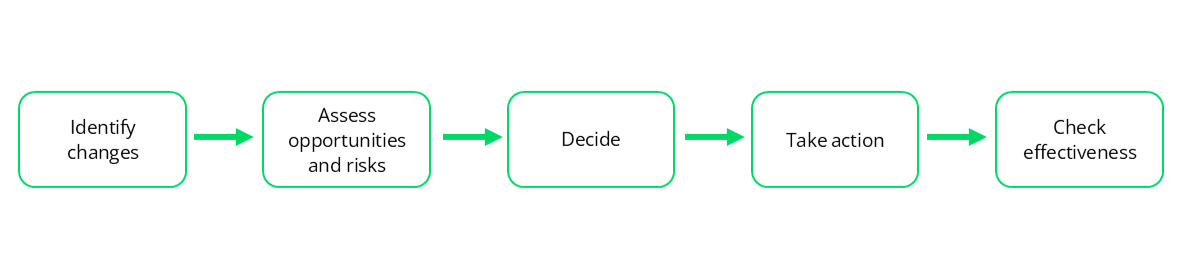
This control cycle in ISO 9001 incorporates many elements of a typical strategy process. The standard itself does not prescribe a complete strategy process. However, it requires the regular review of relevant information and the integration of QMS requirements into business processes (5.1.1 b). If senior management makes consistent use of this link, it simultaneously creates a robust basis for continually reviewing and adapting the organisation’s strategic direction and objectives.
Identifying changes – and taking action in good time
When the quality of existing products is no longer sufficient
The transformation of the automotive industry illustrates this challenge clearly. For a long time, manufacturers and suppliers maintained a high standard of expertise in their established technologies. At the same time, electric powertrains, new competitors and changing customer needs have reshaped the market landscape, demanding new products. Continuously optimising existing performance does not protect against a decline in demand.
An insightful retrospective from audit practice reveals that as early as 2008, an automotive supplier was repeatedly asked how it was preparing for the potential rise of electric mobility. At the time, those in charge dismissed this development as a marginal phenomenon. This observation highlights how important it is not to dismiss early warning signs too hastily, but to regularly examine alternative scenarios and courses of action.
The key question is: what use is mastering the manufacture of a product to perfection if demand for it is set to decline in the future?
Treat opportunities as seriously as risks
Change also opens up opportunities: new customer groups, products, partnerships and technologies. Energy suppliers, for example, must incorporate climate change, shifting energy demand and market upheavals into their infrastructure decisions at an early stage in order to continue meeting their customers’ requirements in the future. Suggestions from staff can often lead to new solutions, provided they are taken on board and implemented swiftly.
ISO 9001:2026 distinguishes more clearly between the management of risks and opportunities and strengthens the planning and effectiveness assessment of changes. For senior management, this provides an impetus not only to avert potential damage but also to pursue future prospects in a targeted manner. Important signals must not be left unaddressed until the next annual review.
Management review – when information becomes leadership
An annual report is not the same as a management review
Quality management representatives often compile key performance indicators, audit findings, complaints, targets and actions in comprehensive annual reports. This information is important – it forms the basis for the management review – but it is not a substitute for it! Simply presenting the report and having it signed by senior management does not fulfil its purpose.
Clause 9.3 of ISO 9001 requires top management to review the QMS for suitability, adequacy, effectiveness and alignment with the strategic direction. In doing so – alongside changes in the context – the requirements of relevant stakeholders must be considered and the effectiveness of measures addressing risks and opportunities must be scrutinised. The review must result in decisions regarding opportunities for improvement, as well as necessary changes to the QMS and its resource requirements. Its business value is particularly significant when management uses it to derive not only priorities and objectives but also implications for the corporate strategy.
The bird’s-eye view
In an effective review, senior management and relevant executives jointly examine the results from a broader perspective:
- Which developments are truly significant?
- Why were targets missed? Have the circumstances changed?
- Do priorities, responsibilities or processes need to be adjusted?
Internal audit findings and the updated context and stakeholder analysis provide important foundations for this. Management draws the conclusions and makes the decisions – that is the purpose of the review.
A comprehensive annual context and policy assessment can be usefully supplemented by shorter quarterly reviews that address targets, key performance indicators, measures and current changes. Such management meetings can tie in with existing management tools. The organisation itself determines appropriate intervals; it must also respond to significant changes between these meetings.
What matters is not whether a management review has been signed, but what insights the management has gained and what decisions it has taken on that basis. |
Learning, adapting and being open to independent questioning
Experience becomes organisational knowledge
Effective quality management does more than just eliminate errors. It investigates causes, evaluates improvements, processes customer feedback and makes knowledge available beyond individual employees. Positive experiences are just as important: good ideas from staff, tried-and-tested procedures and new customer requirements. To this end, ISO 9001 specifically combines organisational knowledge, performance evaluation and continuous improvement.
A prerequisite for this is a corporate culture in which employees can openly address changes, risks and errors, and in which managers take this information seriously. ISO 9001:2026 therefore expressly emphasises the responsibility of top management to promote a culture of quality and ethical behaviour. Only when insights are passed on without distortion, decisions are made responsibly and measures are consistently implemented can the management system achieve its full effectiveness.
This creates an organisation capable of learning, which has reliable control over its processes and can adapt them when new circumstances require it. Adaptability does not stem from having as many documents as possible, but from clear responsibilities, an open approach to findings and consistent action.
An independent audit can bring insights to light
Successful organisations in particular sometimes overlook their own routines and outdated assumptions. Through independent observation, fact-based findings and precise questions, an experienced auditor can reveal the actual effectiveness of the management system.
- Does the context analysis reflect the current challenges facing management that are relevant to the QMS?
- Have risks and opportunities been clearly derived from this?
- Have the necessary measures been taken and their effects reviewed?
Such questions serve to assess effectiveness against the standard and can, at the same time, trigger insights within the organisation.
The boundary here remains clear: the certification auditor does not dictate corporate strategy nor does he or she develop management solutions. The organisation knows its own situation best and makes its own decisions. The value of the external audit lies in a qualified, independent assessment that facilitates reflection through questions and observations – not in covert consultancy.
Six questions for your next management meeting
ISO 9001:2026 is not a new formula for business success. However, it does provide an opportunity to view an existing or newly established QMS in a different light: as an integral part of corporate management that focuses simultaneously on quality, cost-effectiveness and long-term sustainability.
- Are we recognising the developments that could determine our success tomorrow?
Does our context analysis reflect the issues that truly matter to senior management? - Do we regularly and systematically scrutinise our performance and business models?
Do we check whether our products and services will continue to meet our customers’ needs in the future? - Do we capitalise on opportunities just as consistently as we manage risks?
What new opportunities have we identified – and which of these are we pursuing? - Does our management review support our strategic direction?
Is our management review truly a forum for leadership and decision-making that supports our strategic direction?
What key decisions or changes in priorities emerged from the last review? - Do we, as an organisation, learn from our mistakes and successes?
Are insights taken on board, shared, implemented and assessed for their impact? - What benefits does senior management itself derive from the QMS?
Does it help them position the company for the future – or does it primarily serve to demonstrate that today’s customer requirements are being met?
If you hesitate when answering several of these questions, you do not automatically need a new management system. Often, the greatest leverage lies in making more consistent use of the existing one. A rigorous independent audit can provide further insights in this regard.
Quality Management is more than just quality assurance: when properly understood and put into practice, it helps companies to manage change and secure their long-term viability.
- ISO 9001:2026 (English edition), in particular the Introduction, 4.1–4.2, 5.1, 6.1–6.3, 7.1.6, 9.2–9.3, 10.1 and the informative Annex A
- The PESTEL, SWOT and review methods mentioned are recommendations, not additional requirements of the standard.
- The anonymised case study is a personal observation and does not constitute proof of causality.